
More about our services
Business Performance Improvement
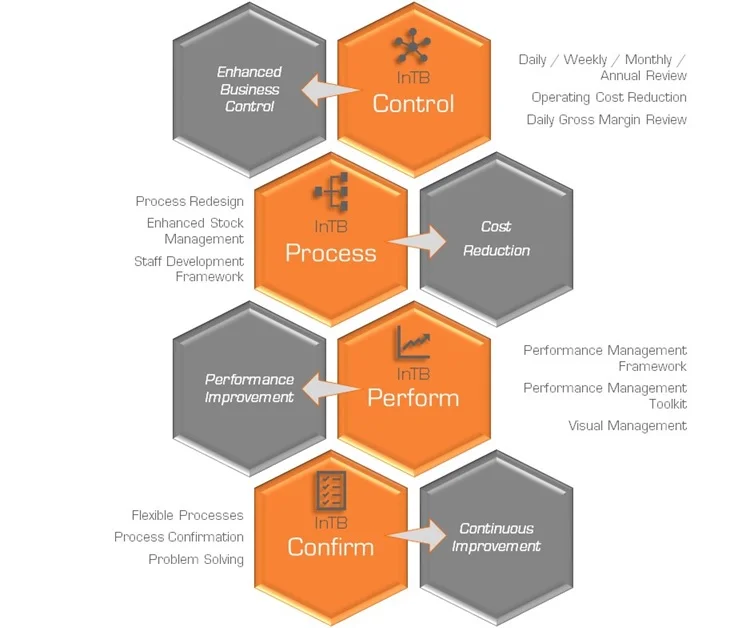
The biggest challenge in driving change is ensuring that the improvements can be sustained. Managing for Daily Improvement - A solution built on experience
We have developed an approach, using experience of the last 20 years in supply chain, that enables us to manage and maintain a culture of continuous improvement within any organisation. By engaging and empowering employees, “Managing for Daily Improvement”, (MDI) creates a culture that inspires and enables people to go the extra mile and actively seek opportunities for continuous improvement in all that they do, for the benefit of themselves, the organisation and its customers.
Sharing our knowledge to help you improve
We can apply our experience to organisations, of any kind, so that they may achieve operational excellence via MDI and increase capability, reduce costs and deliver better service for their customers.
Our policy is to be low risk and highly practical. We can work immediately across your entire organisation or introduce our approach in one area, or department, that can then act as a role model for best practice in your organisation.
Ensuring improvement will be sustained
Whatever the scale, our approach of coaching your people in the use of an integrated system and enabling them personally to design, test and implement their solution, ensures they take ownership.
Results come quickly and are sustained and developed by our focus on creating high levels of employee engagement, throughout all that we do.
Initial benefits will develop further as employees embrace a culture of continuous improvement resulting from their new found knowledge, confidence and enthusiasm. This generates a momentum for change across the organisation.
The outcome is improved capability from a more flexible workforce that will help increase your competitiveness for the future.
The Inside the Box approach is not to “do it to you”, but to “teach you how to do it for yourself”, thereby ensuring a deep sense of ownership and commitment.
Integration / Project management
In today’s highly competitive and fast moving economy, new ideas and innovation are vital. But ultimately, success is all about effective delivery.
Whether deploying the latest IT, integrating operations, or driving business performance improvement, technical expertise and clear leadership are essential to success.
At Inside the Box we have an enviable and successful track record of delivering major change programmes for our customers.
It’s a brutal reality that 70% of projects fail to deliver their anticipated benefits (Office of Government Commerce). By using our "Project Lite" delivery capability, which leverages the PRINCE2 methodology, we enable our clients to realise the full benefits from their projects and programmes.
Our consultants combine broad-based operational experience, technical expertise and a logical approach to problem solving to overcome the many challenges experienced in business implementations in a complex, and fast moving environment.
Outsourcing
If a client were able to achieve its cost, capability and capacity goals by itself, then outsourcing would not be required
By definition, outsourcing requires change. The initial switch from internal to external service delivery is the first and most obvious change. Over time, additional changes are driven by organizational strategy, leadership, available talent/skills, technology, business processes and regulatory requirements. The changes emanate from multiple sources: the client, the service provider(s), or external stakeholders. Consequently, getting buy-in and governance right is not a one-time event, but a continuous process.
However, implementing and sustaining change is one of the more difficult aspects of organizational leadership. It is challenging enough to align multiple stakeholders within the same company who have different priorities and agendas. Outsourcing introduces additional complexities — stakeholders don’t belong to the same company or organization, can include different nationalities and cultures, and may be separated by distance, time zones, languages and commercial interests. Our findings of Top 10 problems point to the critical need for clients and service providers to cooperate and make Change Management and governance a priority. It needs to be integrated into overall program management and not treated as something "nice to have" but as the only way to achieve lasting, mutual success.
Top 10 Problems with Outsourcing Implementations
The outsourcing implementation is when "the rubber meets the road." It is the critical juncture in the outsourcing relationship where:
- Required planning should already be defined in order to initiate the change (including all contract negotiations and implementation preparations by the client and service provider[s]).
- The future groundwork is laid for the enterprise-wide relationship between the client and service provider (i.e, work moves out of the planning stage and begins to impact multiple client leaders, users and other stakeholders).
In our experience the following is a "Top 10" list of client problems with outsourcing implementations.
- Post-Contract Processes and Decision Rights Not Understood
- Little or No Support From Client Leaders Receiving Services
- Poor Mutual Understanding of the Contract
- Client Retained Team Not in Place or Too Small
- Client Retained Team Lacks Required Skills
- Loss of Key Talent (Tacit Knowledge) and/or Poor Knowledge Transfer
- Inability to Meet Pent-Up Demand for Services
- End-User Resistance to Adopting New Methods
- Culture Clash Between the Client and Service Provider
- Changes Don’t Last
Overcoming Problems and Driving Success: A Framework for Action
The lack of sponsorship and commitment are the reasons that issues related to Change Management and governance are so prevalent on our Top 10 list. Change Management may sound like a "nice to have," but — as evidenced by our Top 10 list — it is essential to achieving expected results. To demystify the concept of Change Management, the following drivers provide a framework to lay out a vision, make sure everyone understands their roles and goals, develop a road map to make it happen and then execute.
The drivers include the following elements:
- Leadership Vision and Commitment: client and service provider leaders must be clear about the future state and drive the changes required to get there through words, actions and commitment of appropriate resources.
- Staff Effectiveness: client and service provider staff responsible for negotiating, implementing, performing and managing outsourcing services must have the necessary skills, knowledge and capacity.
- Organizational and Procedural Alignment: client policies, programs and other operating model components are aligned to support and enable the change.
- Governance Readiness: the outsourcing governance model is in place with a shared understanding of responsibility, decision-making authority and how services are managed.
- Change Acceptance and Adoption: client groups and individual stakeholders who are involved understand, accept and are committed to operate according to the new model.